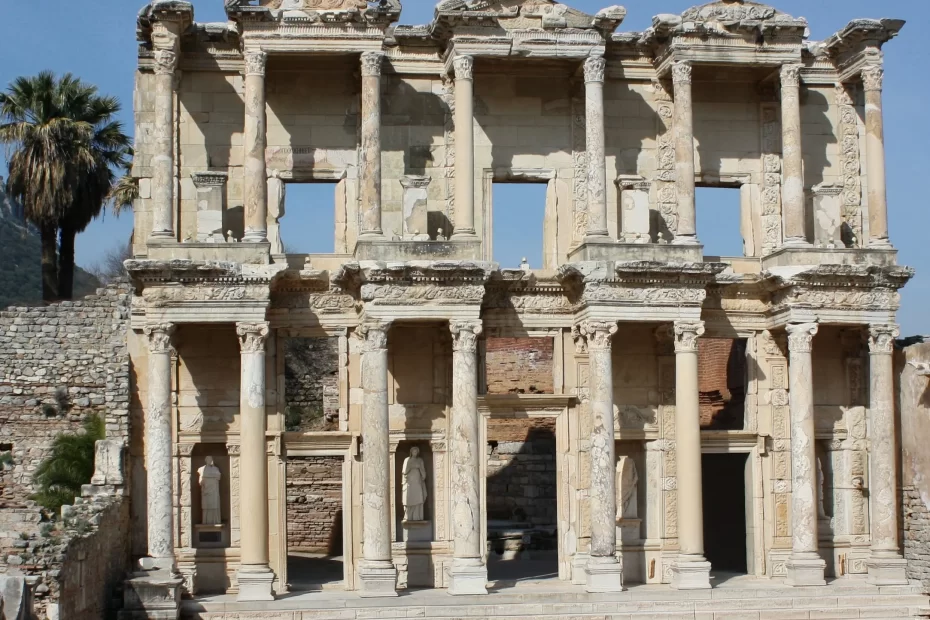
We recently went on a tour to Turkey and Greece with the first stop being the city of Ephesus. Like many sites in Turkey and Greece of the ancient world, Ephesus was “lost” for many centuries and only “discovered” in the last couple of hundred years. Because it was discovered recently, many of the sites of interest to visitors are constantly being worked on and reconstructed while tours are in progress. Ephesus is no exception.
Even though we were there in early March, not the prime tourist season, there were many visitors to the city. Some of the pictures in this post were run through AI programs to help the reader visualize what the site would look like without people around the sites. We were fortunate with the weather as it didn’t rain and was relatively warm, so our tour was quite comfortable.
About Ephesus
At the time the apostle Paul was there, Ephesus was a seaport, one of the busiest in Turkey or Anatolia as it is also known. It was in fact the capital of the Roman province while Paul was there. Since that time the Cayster River and other streams have filled in the area between ancient Ephesus and the present coastline. The current coast is about 3 miles away.
The population of Ephesus during the time Paul was there is somewhat unclear. While the Romans were very interested in counting the people in their conquered countries, they often counted only the freemen. They didn’t always count the women, the children, or the slaves. Estimates vary between 40,000 and 250,000. The other question is, were they just counting the people inside the walls or were they also counting the people on the outlying farms and villages? At this point we will probably never know.
What you will find visiting Ephesus
There are gates at both the top and bottom of the city. If you are with a tour, you will probably be dropped off at the top and picked up at the bottom. If you are driving, you will end up walking uphill one way or the other.
We started at the “top” of the city and walked toward the bottom. One of the first things we encountered were the remains of the baths. Public baths were an essential part of life in the Roman world. The upper baths are still being reconstructed so beyond a few walls, you have to use your imagination about the upper baths.
 Next was the Odeon (sometimes spelled as Odeion). While it looks like a small theater it was probably used mostly for public meetings like city council, or concerts and small performances.
Across from the Odeon was one of the marketplaces or agoras. The top one was called the state agora and was the smaller of the two. Like the Odeon, it was also a place to conduct the official business of Ephesus.
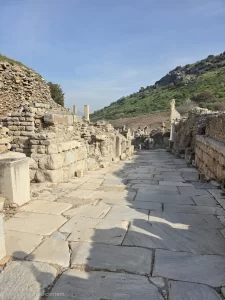 What we would call streets are in places little more than wide sidewalks in Ephesus. Much of the original road structure is largely intact because of the work of archeologists reconstructing the city. They have filled in some spots with other stone or concrete to make walking “easier.” Be warned, however, these streets are not smooth and so if you have mobility problems, take a cane or walking stick.
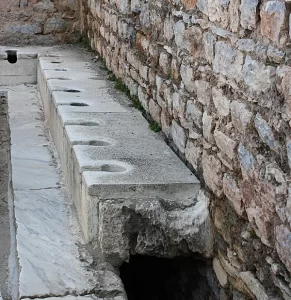 You might want to stop and see what the Romans used as public restrooms. No, there were no walls between the seats. Yes, you were expected to carry on a conversation with your neighbor while “taking care of business.”
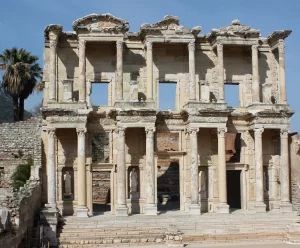 One of the most photographed buildings in Ephesus is the Library of Celsus. It was the third-largest library in the Greco-Roman world after the ones in Alexandria and Pergamum. It may have held as many as 1,200 scrolls – the books of the ancient world. The library was destroyed in 262 CE (AD if you are old school) by either an earthquake and/or invaders, probably Goths.
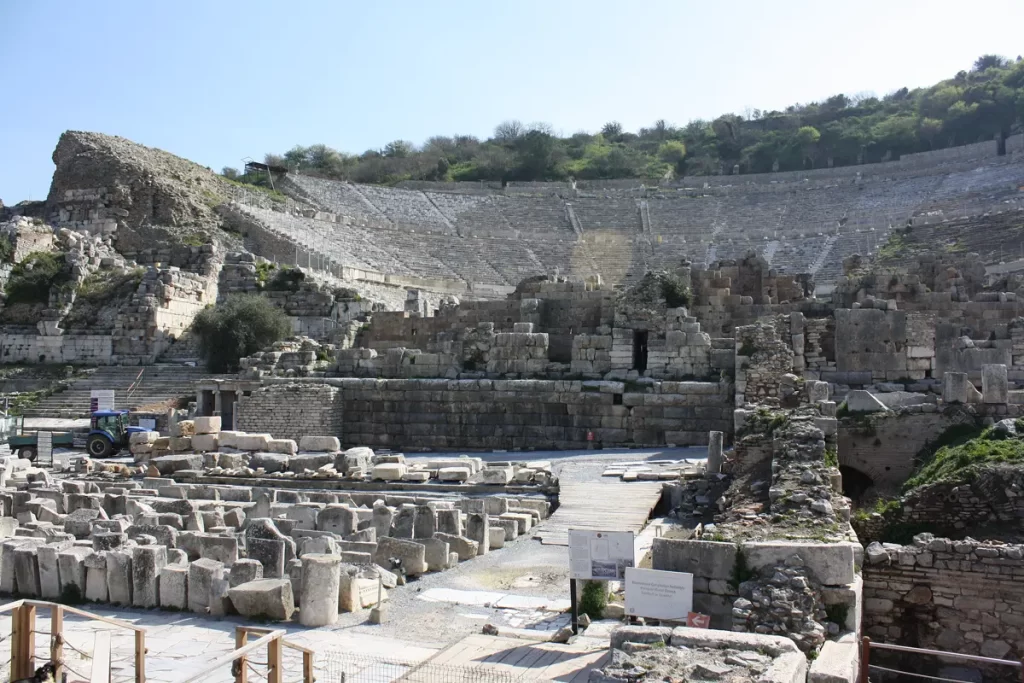 While I have left out much of the reconstructed Ephesus, the last major attraction when you start at the upper gate and walk to the lower gate is the great theater. While the Odeon could seat around 300, the theater could seat an audience of up to 24,000. This structure was used for plays and religious celebrations for large numbers of Ephesians.
Mary’s House
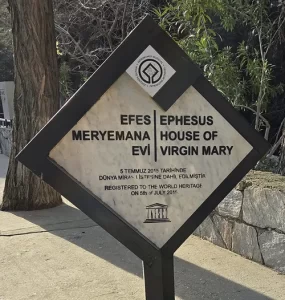 While not in Ephesus, roughly 5 miles away is Mary’s house, a common stop when touring this area. As Jesus is hanging on the cross just before he died, he tasked John with taking care of his mother, Mary. While we don’t know all of the details, toward the end of John’s life, after all of his travels and banishment to Patmos, John took Mary to live is Ephesus. Well, not actually in Ephesus. As our guide put it, to protect Mary from both curious people and those who would do her harm because of Jesus, John had a house built for Mary on a hill away from the Ephesians and those might do her harm. The site was revered for centuries by Christians many who came to be healed. As with many things in the ancient world, the site was “lost.” People searched for centuries for Mary’s final home without success.
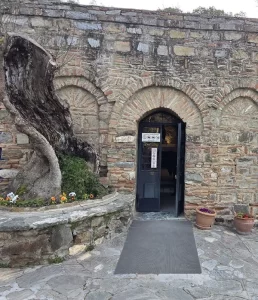 Fast forward to Germany in 1812. A German nun, Sister Anne Catherine Emmerich, had a vision about the Virgin’s House. Quite strange since she never left Germany. She had physical manifestations beyond the vision and was labeled a fraud by many of the people around her. Despite skepticism, her visions were written down and eventually published.
Again, fast forward. This time to 1881. A French Catholic priest used Emmerich’s writings to search for the house around Ephesus and found it’s remains from the descriptions written down from her vision. The foundation of the house was what the priest discovered. Over the years the site has been rebuilt and improved and is now a protected historical site. Previously three Popes officially visited May’s house. 1-1.5 million people visit Mary’s house each year.
One final note, Sister Emmerich was beatified, made a saint, in 2004.