June is Employee Wellness month. But what is wellness and why should employers worry about it. Let’s take the two questions in order.
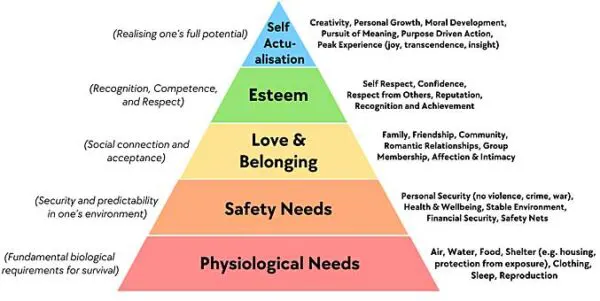 What is Wellness?
Being healthy is absolutely part of wellness. Keeping up with visits to various doctors, dentists and other health professional is the start of wellness. But topic goes way beyond just those things. If you look at Maslow’s Hierarchy, those things are at the bottom of his pyramid in the Physical and Safety Needs areas. Don’t get me wrong, those things are required, but people need more than just their physical and health needs covered.
Being part of a groups
Being a member of a group is in the middle of the hierarchy but it can be an important part of how people fare in this world. Humans are social beings. Yes, some more than others, but if you look at how we evolved, we won’t have survived without the help of others – our group, our tribe. We are not the fastest animal on the planet. Nor do we have sharp claws or the most muscle. We have survived because we can work with others to achieve a goal – survival initially. That group or tribe may start as family or just the people around us but it should grow to a larger group; perhaps our community, or state, or country, or world. Being part of something larger helps us to put our lives and problems in perspective.
Esteem
An outgrowth of being part of a group can and should be a sense of confidence in what we do and the respect of others. By working with and helping others, we gain more confidence in what we can do. It could be as simple as helping others to read or raking up leaves for those who can’t or helping build a house for Habitat for Humanity. But whatever the activity is, it helps us to feel more confident in our abilities as a person. I grew up backpacking and at that time the motto was, “Leave it better than you found it.” Working to help others is one way to leave the world a better place than when we came into it and helps build our own self-esteem.
Self-actualization
The top level of the hierarchy is about becoming more. More through finding a purpose for your life and pursuing it. A Buddhist might say it is part of working toward enlightenment. Rick Warren, in The Purpose Driven Life: What on Earth Am I Here for? says “Without a purpose, life is motion without meaning, activity without direction and events without reason. Without a purpose life is trivial, petty, and pointless.” Too many people are just going through the motions without a reason or purpose to their life. This kind of a life is existing, not living! To have an enjoyable, fulfilled life, people need to identify and pursue a purpose. That purpose may change over time as we go through different life stages, but at least there is something to strive for.
All of these things contribute to a person’s physical and mental wellness.
Now the second part of the initial question – why should employers’ care
At first glance, from a bean counter’s perspective, worrying about employee’s wellbeing has nothing to do with the bottom line and so is a waste of time and resources. Yes, I understand that no employer is responsible for every level of Maslow’s Hierarchy for all their employees, but a deeper dive into the facts will show that in many cases it does make sense for an employer to consider some of those needs.
Absenteeism
From a strictly health point of view, wellness programs lead to reduced absenteeism. People who are physically healthy and who make sure their families are healthy too, miss less work. But there’s more to it than that. Looking back at Maslow’s Hierarchy, we see that people also need to be mentally healthy; for example, feeling connected and part of a group. People who are mentally healthy are less likely to take “mental health” days off. Fewer days off can lead to less disruption of production and greater output. Both of those aspects can be helped by insurance and wellness programs in companies.
Disability claims can be reduced
When I was younger, I worked in an RV trailer plant. Every spring as we were gearing up for the summer camping season, we would work 10 sometimes 12-hour days. It wasn’t unusual for us to work Saturdays too. The money was great, but the number of injuries went up. The more we worked, the more tired we got and the more likely it was that we got hurt from a lack of focus. Almost everyone missed some time because of an injury. That left crews short of people and less productive. Being aware of what people are capable of for a job can help them know the limits of their bodies and minds. Wellness programs can help employees and employers understand these limits better.
Reduced turnover
I worked for one company that kept wages low and provided little to no employee wellness programs beyond just basic health insurance. Their philosophy was that there were always people looking for work so we aren’t going to take care of our people. Yes, there are always people who are looking for work, but it takes time to teach them how to do their job and more time for them to learn how to work efficiently. If that person only lasts 4-6 weeks, then you are pulling another staff member from their regular duties in a never-ending training cycle. A short-term gain in wage reduction rarely outweighs a long-term loss in productivity. Being part of a company the shows its employees it cares, helps to reduce the turnover with all its hidden costs.
Happier, more satisfied employees
Happier, more satisfied employees tend to be more productive and more involved on the company. Satisfaction can lead them to contribute more to the growth of the business. From a social media standpoint, their posts and pictures will help sell products and find quality employees. Angry reviews on Indeed don’t lead good candidates to apply for open positions. Also, some of the best ideas for improvements in products and production come from the people who are making the widgets you sell.
Back to the RV plant, there were times that the engineers would design a new trailer and then send us the drawing to make a prototype. Working though the build of the prototype, we occasionally found huge design flaws that would have made the trailer unstable. We would talk it over with our bosses who then brought the designers out to rework the drawings. Sometimes the people who make your products know more the them than the people who design it.
Having happier, more engaged employees can lead to better products and processes.