Th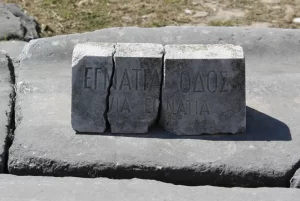 e second stop on our trip was the city of Philippi, now a UNESCO World Heritage site. The city was originally named Crenides but was renamed after being conquered by Philip II, Alexander the Great’s father. One of the reasons this area was important to the ancient world is because of the gold mines in the area. Several invaders exploited that resource. During the Roman period it was a major hub on the Roman highway, the Via Egnatia, and that brought more wealth to the region. The last historical event of note was the battle when Antony and Octavian defeated Brutus and Cassius happened near the city. Philippi and the Church
Philippi also has some interesting church related history. During Paul’s second missionary trip in Anatolia, he felt the spirit of Jesus blocking him from continuing as planned for this journey. While in Troas he received a vision of the man from Macedonia. In this vision, the man asked Paul to come to Macedonia and help them. This led Paul to change his plans. Instead of continuing preaching in Anatolia, he sailed to Samothrace in Macedonia with Silas, Timothy, and Luke.
From Samothrace the missionaries traveled to Neapolis, known today as Kavala. Finally, the group traveled on to Philippi. This journey took several days walking to complete.
While staying in Philippi, the group of missionaries went out of the Philippi to the river to pray. In an unexpected twist to them, at the river they met Lydia. She was originally from Thyatira, now known as Akhisar, a city in Anatolia. At that time, Thyatira was a prosperous city known for dyeing cloth, bronze work and leather work. Of those professions, Lydia was a dealer of purple cloth. Dealing in purple cloth may not seem like much in today’s world, but during Paul’s life, only emperors and a few people of power were allowed to wear purple. That is because the dyes to make purple cloth were expensive, rare, and hard to produce.
From this chance meeting, Lydia is considered the first convert to Christianity in Europe. Not only did Lydia convert to Christianity, but her household was also baptized. The mission group stayed with her for a time while they were in Philippi.
Things to see in Philippi.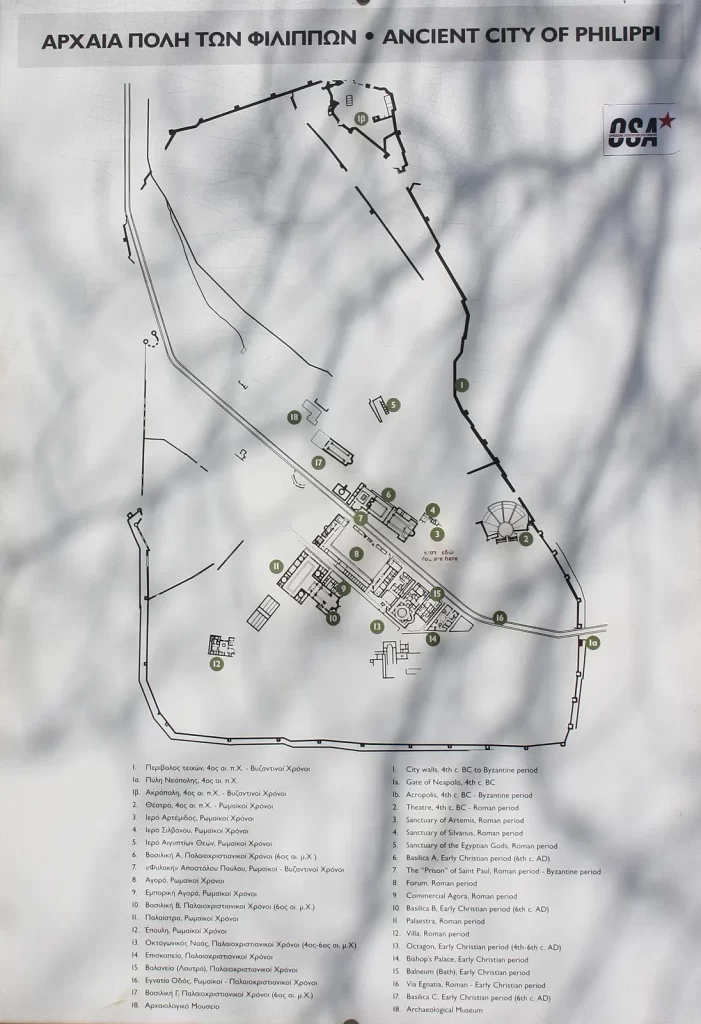
Just like at Ephesus, there is a gate to get to the archeological site that was ancient Philippi. This is one of many Heritage sites in Greece, Turkey, the Holy Land and around the Mediterranean.
After walking up a short hill, you will pass through what was one of the gates through the city wall. The gate is gone but the remains of the wall can still be seen. The marker at the lower left of the map indicates that old gate.
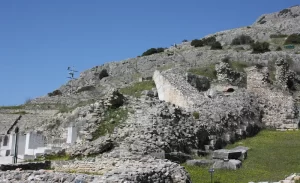
This picture is looking up the hill in the direction of the fortress.
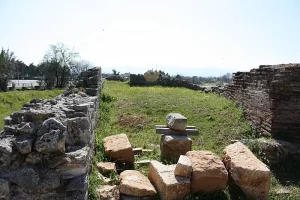 This picture is looking down the hill toward the modern-day city of Krinides.
There are several routes you can take through the site. Our guide led us to the right and further up the hill to the theater. On the map, again we approached from the lower right.
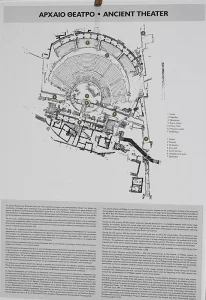
This theater isn’t as big as the one at Ephesus but is follows a similar design with the seating. Some of the original marble still exist in ancient structures and this theater is no exception. A few of the walls and passageways are the original stone but seating is often replaced or updated.
Many of these ancient theaters are again used for theatrical performances. To ensure safety and comfort, decent seating has been added for the audience. One difference was the fully round orchestra of this theater instead of the half circle one at Ephesus. That shows the stronger Greek influence here over the Roman renovation in Ephesus.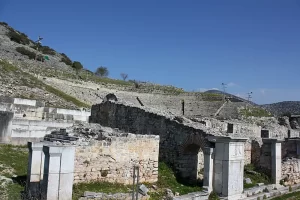
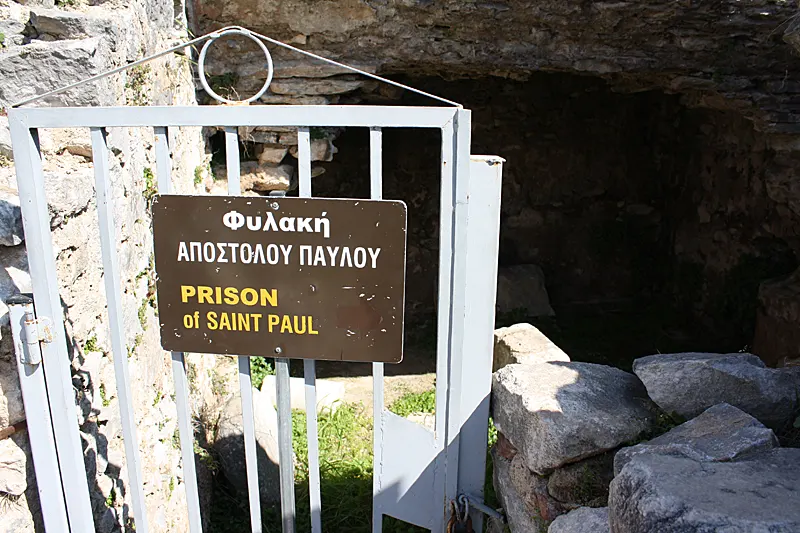 As time passes and more work is done, both archeologically and scholarly, the view of events from ancient times can change. One example of that is Paul’s Prison. There is a gate with a sign guarding a deep hole or grotto in the city of Philippi. You may recall the story in Acts 16 about Paul and Silas being imprisoned in Philippi for casting a demon out of a slave girl. There was an earthquake and the doors of the cell were thrown open. The guard was so certain that all the prisoners had escaped that he was about to commit suicide. Paul called out to him that they hadn’t left so the guard should kill himself. After that the guard converted and he and his household were baptized. This picture shows the traditional place where Paul and Silas were supposed held after being arrested. Generations of visitors have been led to this spot and told the story of Paul’s imprisonment.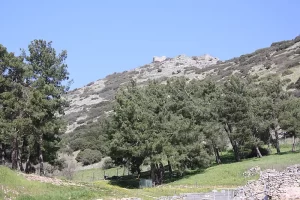
This place is known to have been used as a water cistern. Some current thinking is that Paul and Silas were not held here in the middle of the city. Those scholars believe they were held in a cell in the fortress on top of the hill behind Philippi.
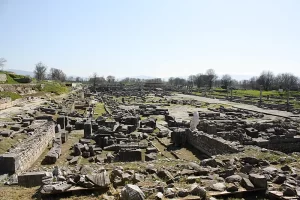 The center of the most ancient cities was the marketplace, or the agora. Philippi was no different. The ruins you see here would have included temples, a library, a courthouse, and shops. This is where Paul, Silas and the others went regularly to spread the Word.
To the left of this picture, you can make out a flat area that was the Via Egnatia. Via Egnatia was a major Roman road. It ran through modern Albania, North Macedonia, Greece, and European Turkey. The Via Egnatia was part of what made Philippi such an important city in ancient times. Also, because it was a Roman road, Paul, as a citizen, had some protection when he traveled on his missionary journeys. You can still see some of the ruts in the stone of the road. 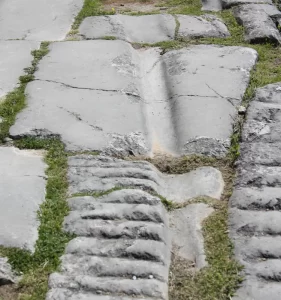
The ruins in the distance of the agora picture include an ancient church, the bishop’s palace, baths and other remains of the old city.
There were portions of the city closed when we were there. There are constant excavations in many ancient cities as they try to uncover their past.