The city of Corinth was the next major stop as we traced Paul’s second journey through Greece. This was also the furthest south of our travels. Paul spent about a year and a half in Corinth planting and building a church there. Later Paul “wrote” at least two letters to the Corinthians during his later travels. He may have written more than two, but they don’t appear in the New Testament.
On The Way to Corinth
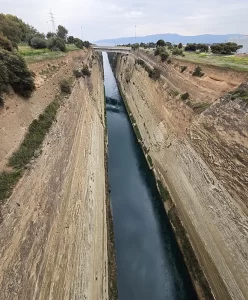 Corinth Canal – A common stop on the way to ancient Corinth is the Corinth Canal. The original idea to cut a canal between the Ionian and the Aegean Seas go back almost 3,000 years. It was tried several times during that period but was finally completed in 1893. The canal is about 4 miles long and as much as 300’ deep. Unfortunately, by the time it was finished, most ships had grown wider than the canal cut. The canal is still used by smaller boats, both commercial and private.
Things to see in Ancient Corinth.
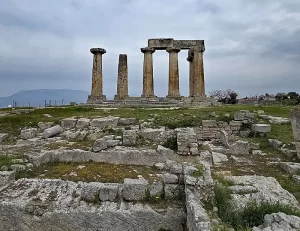 Temple of Apollo – even though the patron god of ancient Corinth was Poseidon, the major remaining temple is to the one to Apollo. It was built in the Doric style with 7 original 42 columns remaining today. The temple is a little over 175’ by 70’. Like most archaeological sites in Greece, visitors can only view the temple from a distance and not actually step on the remains.
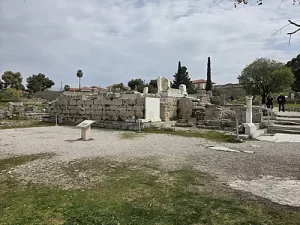 In the Roman Forum of ancient Corinth is the Bema. This is the platform where St. Paul was tried in front of the Roman governor Gallio in 52 AD. The Jewish community accused Paul of trying to convert Jews to Christianity which was against Jewish law. After hearing the arguments, Gallio dismissed the case, saying it was a religious dispute, not a civic one.
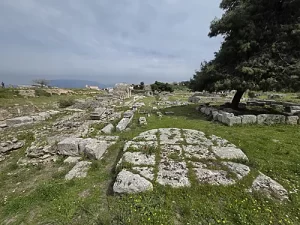 Close to the Bema is the Agora or the marketplace. This was probably a place the Paul frequented. He often went to places where people gathered attempting to spread the good news of Christ.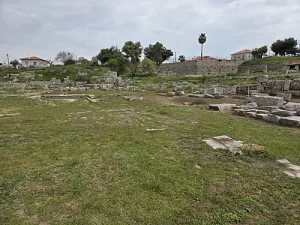
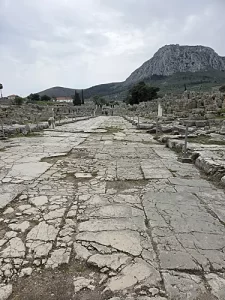 The Lechaion Road – is a Roman road that connected Corinth’s agora the port on the Corinthian Gulf for trade and commerce. At one time was lined with shops, covered walkways, fountains, and religious buildings. During Paul’s time, the harbor was a close walk to the city. Over the centuries the land below the city has been filled in with silt. That and land upheavals pushed the shoreline back 2 to 3 miles from the original city site.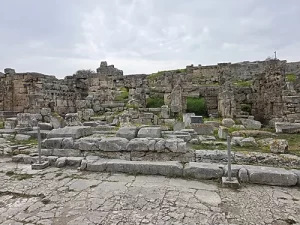
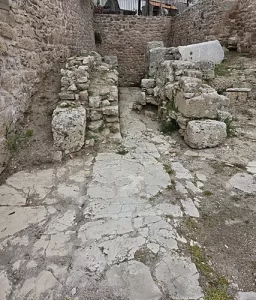
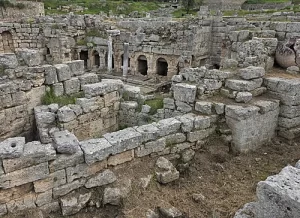 Near the Lechaion Road, there is a sacred spring also known as Pirene. One of the myths about the spring names it as one of Pegasus’ favorite drinking spots. In ancient times, poets would drink from the spring, hoping the Muses might help them with their vocation. The spring was probably not for public use but more likely used for religious ceremonies.
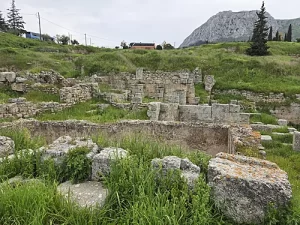 Theater – there are both a theater and an odeon at ancient Corinth; well, at least there were. There isn’t much left of either one. The original theater could hold around 18,000 spectators. The odeon was smaller, seating about 3,000. To access both you will need to work your way down a long set of stairs and a path across the parking lot.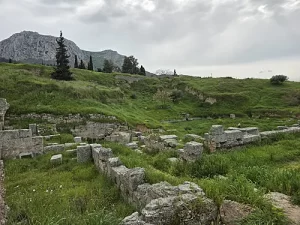
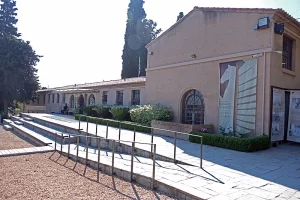 Museum – The museum can be visited either when entering or leaving the site. It includes a collection of artifacts originally found in Ancient Corinth. Some of the artifacts were unearthed by early archaeologists. But a few were recovered from thieves planning on selling them for profit.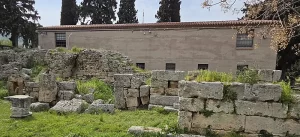
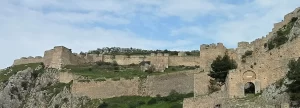 Another side trip in the Corinth area is the castle of Acrocorinth. It sits on a mountaintop overlooking the ancient city. What’s visible now is the latest version of the fortification there in its 3,500 year history. The earliest builders were ancient Greeks and Mycenaeans but crusaders, Byzantines, Venetian, and Ottomans added to the structure. You will need to drive about ½ mile up a winding road to get there. There is a restaurant near the castle if you need a break.
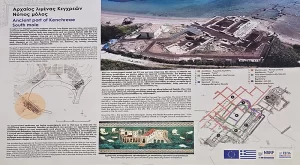
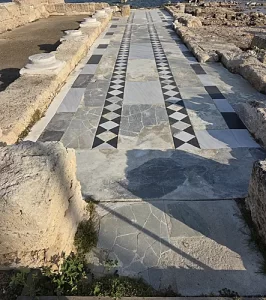
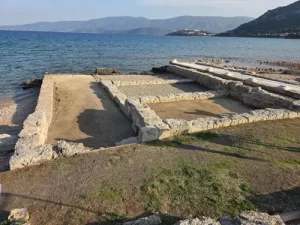
After visiting Corinth, you may drive on to Athens. If you do you will pass close to Kenchreae or Cenchreae. Kenchreae is the port that Paul left from to go on to Ephesus.